
March 2, 2026
How FEC operators can use data to make smarter decisions
Operation
Revenue generation
Valo Motion Service
Ready to make data-driven decisions at your FEC?
Talk to our team
Prakhar Sharma
Content Specialist at Valo Motion, helping operators grow through actionable content.

You know the numbers matter. Revenue per guest, repeat visit rates, and peak hour utilization. The question is whether you have time to look at them between managing staff, handling a birthday party booking, and fixing the redemption counter.
Most FEC operators don't. You're running operations, not analyzing spreadsheets. The data sits in a dashboard somewhere while you handle the next thing that needs your attention.
Here's where digital attractions with service platforms like Operations Hub give you an edge. The data you need is designed to scan quickly. Open the Status page, scan three key metrics, spot the pattern, and make the decision. Five minutes, not fifty. No pivot tables, no analyst required.
This is Part 4 and the final post in our Operator Productivity Series. We've covered automated scheduling, marketing systems, and operational execution. This post closes the series with the data habits that show you what's working and where to invest next.
The tips below don't require advanced analytics skills or a big budget. They require attention, consistency, and a willingness to act on what the numbers tell you.
Let's finish the series strong.
Read more about: How play value impacts your digital attraction's real ROI
Read your FEC’s data in five minutes, not fifty
The Operations Hub Status page is designed for busy operators. You don't need to export spreadsheets or build pivot tables. Open the dashboard, scan the key metrics, spot the pattern, act on it.
Over the last 10 years, Valo Motion has worked with over 1,000 operators across 80+ countries. The metrics you see in Operations Hub are the ones curated with customer feedback, over time, to give them exactly what they need to assess digital attraction performance and optimize their revenue. Here's what to look for.
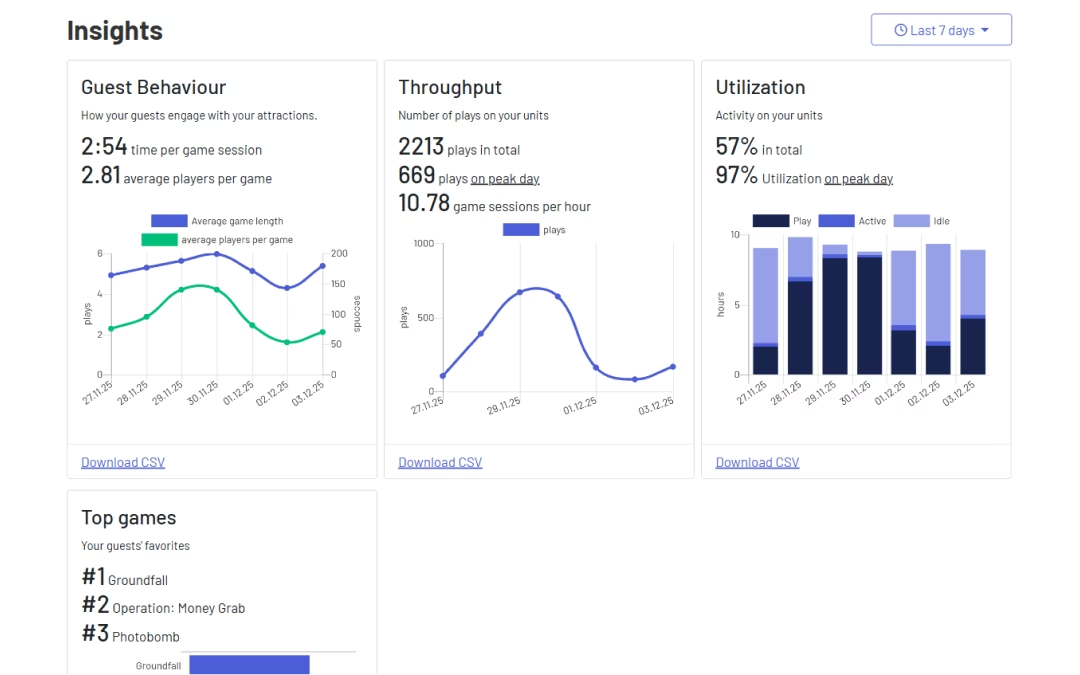
- 📊 Check your Status page at the same time every day
Pick a time that works for your routine. Morning coffee. Right before opening. End of shift.
Daily checks let you spot patterns fast. You'll notice when Thursday suddenly outperforms Friday, or when a specific game starts trending down. Five minutes daily beats two hours at month-end trying to remember what happened three weeks ago.
Build the habit first. The insights follow naturally.
- 📈 Compare peak hour performance to total performance
Your dashboard shows two utilization numbers: peak hour and total. The gap between them is your opportunity.
If your peak hour hits 75% utilization but your total sits at 40%, that's a 35% capacity gap you can fill with targeted programming. Same attraction, different audience, more revenue for your FEC.
Peak performance shows what's possible when everything clicks. Total performance shows where you have room to grow. The gap is where you focus your energy.
- 🎮 Use top games data to drive your marketing
When your guests play the same games again and again, they are voting on what is popular at your venue. The top games list in Operations Hub shows you the results.
Use this in your marketing. If Hullaballoon or Groundfall consistently ranks #1, put it in your social media posts. Feature it in your email campaigns about birthday parties. Show it in your walk-in promotions.
Save your experimental marketing budget for testing new offerings. For reliable conversions, stick with your proven winners.
- ⏰ Find the dips in your utilization chart
Low-traffic hours aren't a problem. They're an invitation to fill capacity with a different audience.
Tuesday mornings run quiet? That's when school groups can visit without competing with your evening crowd. Weekday afternoons slow? Corporate team-building sessions fit perfectly in that window.
You're already paying for the space and equipment during those hours. Strategic programming turns available capacity into revenue without adding infrastructure.
- 🔍 Use filters to compare weekday vs weekend patterns
Weekday guests and weekend guests behave differently. Your data should reflect that, and your strategy should too.
Filter your dashboard by day of the week. Notice which games dominate on Saturday vs Tuesday. Check when the throughput peaks on different days. Identify which hours perform best for each audience type.
Then adjust accordingly. Your weekday marketing should target different groups, promote different games, and emphasize different benefits than your weekend campaigns. Generic "come visit us" messaging treats all days the same. Data-informed marketing treats each day strategically.
- 💰 Track throughput trends to optimize staffing
More plays mean more guests in your venue. Throughput data shows you when to add staff at front desk, party areas, and food service.
Check your plays-per-hour trends by day and time. You'll see exactly when your venue gets busy and when it's quiet. High-traffic periods need more reception staff to handle walk-ins, party check-ins, and guest questions. Slower periods can run leaner.
Even though Valo Motion attractions are designed to run without staff supervision. But your front desk, party operations, and F&B still need people. Don't overstaff Tuesday mornings. Don't understaff Saturday afternoons. Let throughput data show you where to invest your payroll budget.
📹 Here's how to navigate inside the Operatioons Hub:
Beyond the dashboard: choose the right metrics for your FEC
Not every FEC operates the same way. Start by looking at how your venue creates value and generates revenue. The metrics that matter most depend on your business model.
A gated-admission park where guests pay once and play all day tracks different numbers than a pay-per-play arcade or a bowling center running league nights. Here's how to think about what matters for your venue:
- 📊 Pick metrics that match your revenue model
Industry KPI research across FECs, bowling centers, and amusement venues shows three metrics consistently correlate with profitability: average revenue per guest, capacity utilization, and labor cost percentage. But how you measure them depends on how you charge.
If you run gated admission (pay once, play all day): Utilization percentage is your primary lever. You're not charging per play, so you need to know how well you're filling capacity during open hours. Peak utilization above 70% signals strong demand. Low overall utilization shows available capacity you can optimize.
If you run pay-per-play: Revenue per guest and throughput (plays per hour) matter more than utilization percentage. You make money on transactions, not time. Track which attractions generate the most plays and revenue per square foot.
If you run bowling lanes or timed sessions: Revenue per available lane hour (or bay hour, court hour) is the standard. This captures both utilization and pricing effectiveness. Industry benchmarks focus on average spend per guest, combining lane fees with food and beverage revenue.
For bowling operators: We recently covered how group-ready digital attractions fill Saturday slots and unlock new revenue streams: How Bowling Alleys Can Unlock New Revenue.
The question to ask yourself: "What action can I actually take if this number goes up or down?" If the answer is unclear, that metric belongs in your monthly review, not your daily check.
- 💼 Watch labor cost percentage like you watch revenue
FEC and bowling KPI frameworks treat labor cost percentage (labor spend ÷ total revenue) as a key profit factor because small changes compound fast.
Industry guidance from cost-efficient entertainment businesses suggests keeping labor cost percentage below 30% of revenue. When this number climbs higher, it often signals a mismatch between staffing levels and actual guest traffic, which affects profitability.
Check this number weekly, broken down by time of day. Your Monday morning labor cost should look different from your Saturday evening labor cost. If it doesn't, you're scheduling the same way every day regardless of actual traffic.
Once you see the pattern, adjust your schedule accordingly. Add one person to Saturday afternoon shifts. Schedule shorter shifts for Tuesday mornings. Build a staffing plan that matches your traffic, creating better work-life balance for your team while protecting your margin.
Modern digital attractions like ValoArena, ValoClimb, and ValoJump can easily run without staff supervision. No headsets, controllers, or wires. No player onboarding process. No heavy maintenance. Guests walk up, play, and leave with a smile. This way, your team can focus on customer service rather than babysitting the attraction.
If you want to evaluate what works for your space and budget, our team can help: https://www.valomotion.com/contact/call
- 📐 Build your own tracking if you need to
If your POS or booking system doesn't calculate a metric you need, build a simple formula in a spreadsheet (with modern AI tools, it's even faster!).
Revenue per square metre (/foot) by attraction: (Total revenue from Attraction A ÷ square feet Attraction A occupies) = revenue per square foot
Compare this across attractions. The ones with high revenue per square foot are your workhorses. The ones with low revenue per square foot might need better marketing, repricing, or replacement.
Here’s a snapshot of how operators with different business models are seeing results with ValoArena.
Party package profitability: (Package revenue - direct costs like food, staff time, redemption) ÷ package revenue = margin percentage
Not all party packages are equally profitable. Track which ones generate volume at healthy margins. Promote those. Quietly retire or improve the ones that fill your calendar but don't make money.
The pattern: start with a question ("Which party package actually makes us money?"), then work backwards to figure out what data answers it. Don't track metrics because they're available. Track metrics because they inform decisions.
For more on birthday party business at your FEC, the Birthday Profit Formula series covers revenue, packages, marketing, and operations:
- Part 1: Are you missing out on revenue from birthday parties?
- Part 2: How to design birthday party packages that sell out
- Part 3: Marketing strategies to sell more birthday parties
- Part 4:How to make birthday party operations easier (and more profitable)
Venues that grow consistently do one thing differently. They check their numbers regularly, spot patterns as they form, and make adjustments while they still matter.
That doesn't require a data analyst or a degree in statistics. It requires five minutes daily, a clear view of what matters, and the discipline to make small adjustments based on what you see.
With this, we conclude the Operator Productivity Series:
Part 1: How automated scheduling reduces workload for FEC operators
Part 2: Marketing tips for your FEC that don't burn your budget
Part 3: How to streamline your FEC operations and win back your day
Part 4: How FEC operators use data to make smarter decisions (you are here)
If you operate Valo Motion attractions, the Operations Hub gives you these systems out of the box. Daily metrics, automated scheduling, marketing tools, and operational control, all in one dashboard designed for busy operators.
The Operations Hub gives operators immediate insight into how their digital attractions are actually performing on the floor. When you can see your earnings, utilization, guest behavior, and top-performing games in real time, you quickly understand where to focus staff, how to optimize peak hours, and how to generate more revenue from the same square footage.” - Sven Rösch, Head of Sales at Valo Motion.
If you're evaluating digital attractions for your venue, our team can walk you through how Operations Hub supports indoor entertainment operators across 80+ countries.

