February 19, 2026
How automated scheduling reduces workload for FEC operators
Revenue generation
Valo Motion Service
Operation
Ready to automate your venue scheduling?
Talk to our team
Prakhar Sharma
Content Specialist at Valo Motion, helping operators grow through actionable content.

You know that Sunday night feeling? When you're mentally running through Monday's checklist: staff schedules, birthday party bookings, the redemption counter that needs restocking, ads that expired last week, and whether Unit 3 is actually going to power on tomorrow morning or give you grief again.
Running a venue in 2026 means you're the tech person, the marketing department, the operations manager, and sometimes the janitor, all before lunch.
Here's what we've noticed after working with hundreds of operators around the world: the ones who sleep well at night have figured out a secret. They've stopped trying to do everything and started building systems that work without them. Their staff knows exactly what to do. Their equipment runs on autopilot. And when problems arise, the systems catch them early.
This is Part 1 of our Operator Productivity Series, where we're breaking down the exact systems top-performing venues use to run lean operations. We'll cover automation, marketing, operations, data, and guest experience. Each post gives you snackable, actionable tips you can implement this week.
In this post, we're focusing on the foundation: automated scheduling. Because if you're still manually powering on digital attractions every morning or walking the floor to shut everything down at night, you're burning hours on tasks that technology should handle.
Let's talk about how to build scheduling systems that reduce your daily workload while actually improving reliability.
Why systems thinking matters for you as an operator
Before we get into the tactics, let's talk about the mindset shift that makes everything else work.
Most operators think in tasks: "I need to power on Unit 3." "I need to check if the birthday party reminder went out." "I need to update that Facebook ad."
But the best minds in the industry tend to think in systems: "How do I make sure equipment is always ready when we open?" "How do I ensure every birthday party gets at least three touchpoints before they arrive?" "How do I keep marketing fresh without thinking about it every week?"
Systems thinking means creating connected processes where one thing triggers the next, so your venue runs smoothly without constant oversight. Individual tasks require your constant attention. Systems run whether you're there or not.
Here's the pattern we see in successful venues:
- Identify the repetitive task that eats time
- Build or buy a system that handles it automatically
- Monitor the system periodically, not constantly
- Free up that time to focus on tasks that require human expertise, like guests, not equipment
Automated scheduling is where most operators see the fastest return on this approach. Let's get specific.
Automated scheduling: Set it once, forget it daily
Technology should work for you, not the other way around. The best venues automate the repetitive tasks that consume hours every week, freeing their team to focus on guests instead of equipment.
Today's FECs serve digital-native Gen Z and Gen Alpha audiences alongside families who grew up with analog entertainment. That means you're likely running both traditional attractions and digital interactive experiences. The digital side offers automation opportunities that directly impact your daily operations.
- ⏰Set your digital attractions to power on before you open
Manually powering on every morning creates unnecessary work. Your team unlocks the doors, walks to each unit, powers everything on, then waits to see if systems are ready before greeting the first guest.
Automated scheduling eliminates this routine. Set your digital attractions to power on 15-30 minutes before opening. When you arrive, everything's already running and ready for guests.
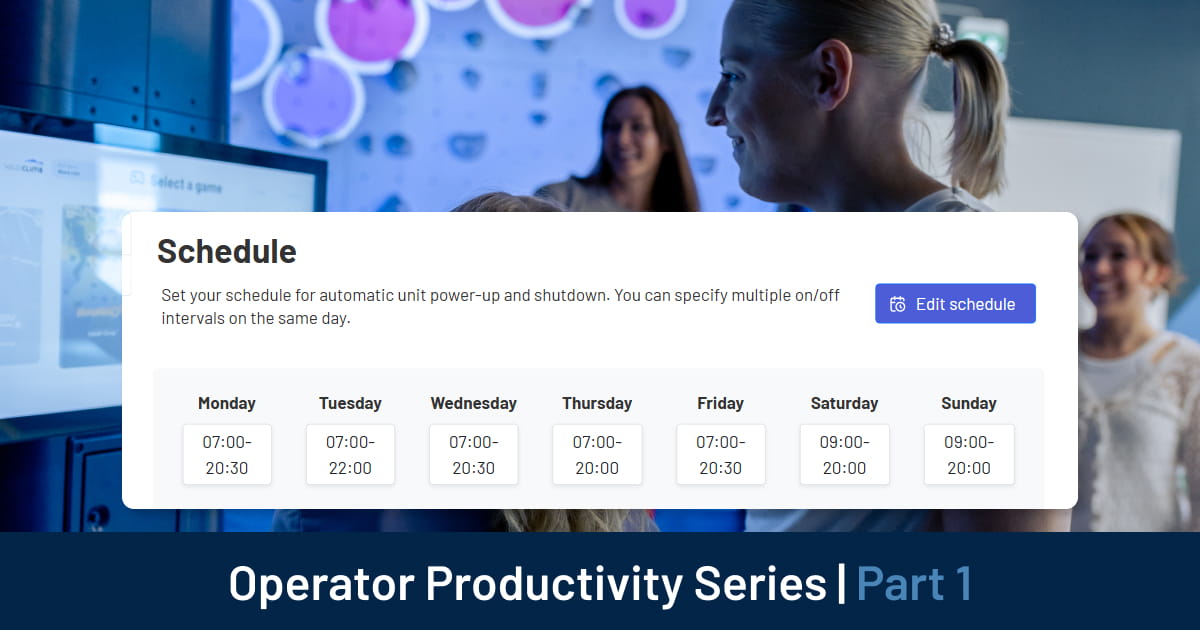
Valo Motion attractions handle this through the Operations Hub. You configure the schedule once, and your ValoJump, ValoClimb, and ValoArena units power up automatically. Your staff can focus on setup tasks that actually need a human touch.
The systems thinking here: You're building a morning routine system where equipment readiness happens independently of human action.
- 📅Weekend schedules should differ from weekdays
Most venues operate longer hours on weekends. Your equipment schedule should reflect actual traffic patterns.
Set separate schedules for weekdays and weekends. Monday through Thursday might run 3 PM to 9 PM, while Friday through Sunday run 10 AM to 10 PM. Your attractions power down during quiet periods and operate during peak hours without manual intervention.
DID YOU KNOW: You can automate Rush Hour mode on ValoJump to limit game lengths to 1 minute during peak hours 💡
The systems thinking here: Your schedule adapts to your business rhythm automatically. No Sunday night reminder to adjust hours for Monday, unless there’s a special reason.
- 🍔Use multiple ON/OFF intervals for split operating hours
Most venues run continuously from opening to closing, one schedule per day. But if your venue operates on a split schedule, opening in the morning, closing mid-day, and reopening in the afternoon, the Operations Hub supports this with multiple operating intervals.
Set your morning session from 9 AM to 12 PM, afternoon session from 2 PM to 6 PM, and evening session from 7 PM to 10 PM. Your attractions automatically shut down during closed hours and restart when you reopen. Operations stay structured and reliable without manual intervention.
This approach also reduces energy consumption and operating costs during the hours you're closed.
The systems thinking here: Energy management and equipment longevity happen as a byproduct of smart scheduling, not through constant manual monitoring.
- 🔧Manual override stays available when you need it
When automated schedules handle 95% of your operations, the other 5% requires flexibility.
You retain manual control for maintenance testing, private events that run late, or unexpected schedule changes. Override the automatic schedule directly from the attraction's interface. Normal scheduling resumes the next day.
With Valo Motion's Operations Hub, you manage scheduling across all your Valo Motion attractions from one dashboard on your phone or desktop. We recently revamped the platform to make multi-unit scheduling even more streamlined. Learn more about how it supports venue operations here.
The systems thinking here: Good systems have escape hatches. Automation handles the routine, but you stay in control when exceptions arise.
📹Here’s how you can do these simply with Valo Motion Operations Hub:
Already running Valo Motion attractions? Our Customer Success team is available 24/7 to help you optimize your Operations Hub scheduling. Whether it's a busy Saturday afternoon or a public holiday when your venue is bustling, reach out at support@valomotion.com. We're here to help.
The Operations Hub is part of our active service plan, which provides your venue with predictable daily operations. The plan ensures the right support, updates, and tools are in place, allowing your team to focus on guests instead of equipment
Extend the automation mindset beyond equipment
The scheduling system proves the concept. Now apply the same thinking to other repetitive workflows. Two areas consistently deliver the highest return on invested time:
- 🎟️ Self-service guest check-in
The best venues move the purchase decision online, before guests arrive. When families book and pay through your website or mobile app, they walk in ready to play. No front desk queue. No payment friction. Your staff greet them and point them to their attraction.
For guests who arrive without booking, self-service touchscreens handle registration, waivers, and activity selection on the spot. The best implementations integrate with your POS system, so payment, activity selection, and waiver completion happen in one flow.
This dual approach, online booking for planners, touchscreens for walk-ins, scales with your traffic without adding headcount.
The systems thinking here: Your front desk capacity isn't limited by how fast staff can type. The system scales with demand.
- 🎂 Automated booking workflows
Birthday parties and group events generate predictable communication patterns: booking confirmation, waiver reminders two days before, and post-visit thank-you messages. Systems that automate these touchpoints free your team from repetitive email chains while ensuring parents get timely information.
The key is integration. When your booking system talks to your POS and marketing tools, one data entry triggers the entire communication sequence. Your team books the party once, and the system handles everything else.
The systems thinking here: Customer communication becomes a system, not a series of manual tasks someone might forget during a busy shift.
We’ve written some more articles you’d find useful for birthday parties, start here: Are you missing out on revenue from birthday parties? | Valo Motion
Start with one system, prove the value, and expand
Start with scheduling. It's visible, measurable, and immediate. Your team will notice the difference on day one. Once you've proven the time savings, expand to the next area.
In Part 2 of this series, we'll cover marketing systems that keep your venue visible without constant manual effort. You'll learn how to use the Operations Hub's marketing features alongside broader strategies that fill your calendar.
Coming in this Operator Productivity Series:
- Part 1: How automated scheduling reduces workload for FEC operators (you are here)
- Part 2: Marketing tips for your venue that don’t burn your budget
- Part 3: How to streamline your FEC operations and win back your day
- Part 4: How FEC operators can use data to make smarter decision

