April 14, 2026
How play value impacts your digital attraction's real ROI
Revenue generation
Mixed reality
Get in touch with Valo Motion
Contact Sales

In today’s FECs and indoor activity parks, the real differentiator is no longer the biggest screen or the brightest lights. Your guests have already set the bar at home. Roblox. Fortnite. Minecraft. These aren't just games; they're the standard your digital attractions are measured against the moment a guest walks through your door.
The difference comes down to one thing: play value. Play value is the difference between an attraction guests try once and move on from, and one they line up to play again. For operators, play value directly impacts the bottom line.
This article explores why play value is an important criterion when choosing a digital attraction, and what operators should ask before their next investment.
Your real competition: high-quality home entertainment
The venue down the street is not your biggest competitor. The games your guests played last night are. Young audiences grow up with Roblox (118M daily users), Fortnite (44.7M daily users), and Minecraft (350M copies sold). These are not casual distractions. They are deeply engineered experiences built around:
- Multiple games or modes in one platform: players never exhaust them in a single visit, so there's always a reason to return
- Clear progression through levels, skills, or scores: players feel improvement is possible, and improvement is motivating
- Social play: these games are where friends meet, compete, and hang out, which is why groups book time around them
- Regular content updates: the experience evolves, so playing again feels genuinely different from the last time
These games don’t rely on a single mechanic or visual hook. They succeed because players can return again and again, finding something new to master, explore, or share. That expectation carries directly into FECs and indoor activity parks.
What can higher game engagement mean for your bottom line?
What does a higher game engagement and play value mean for operators? Motivation research shows three things that keep players engaged:
1. Competence: feeling skilled and improving. Players want to feel they are getting better. Scores, levels, personal bests, and mastery signals reinforce that time spent playing is meaningful. For operators, this means players don't feel done after one session. They come back to beat their score. They bring a friend to prove they can win.
2. Autonomy: meaningful choices and control. Players stay engaged when they can choose how they play, different modes, difficulty levels, or strategies, rather than being locked into a single experience. For operators, this means the same attraction serves different guests differently. The eight-year-old and the fourteen-year-old are not playing the same game, even if they're standing in the same space.
3. Relatedness: playing with and against others. Social interaction amplifies everything. Friendly competition, shared wins, and spectator energy transform individual play into a group experience. For operators, this is the engine of birthday party bookings, group visits, and organic social media content.
When all three are present, the business outcomes follow directly:
- More repeat plays per visits, guests queue again in the same session
- More repeat visits, families and friend groups return because there is still something to master or beat
- Stronger group and birthday bookings, social play is a booking trigger
- Higher revenue per square meter/feet, a high-play-value small footprint attraction outearns a low-play-value large foortprint attraction
- Longer attraction lifespan, the investment delivers returns in year three, not just at launch
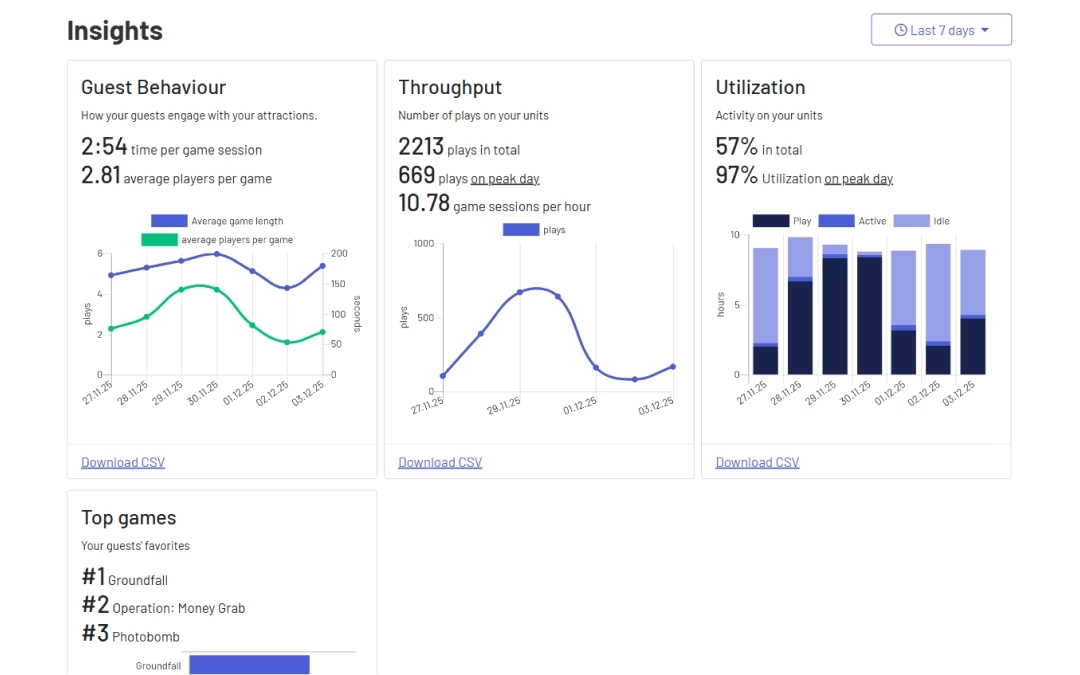
The analytics from Valo Motion Operations Hub confirm this in practice. Staff intervention rate on Valo Motion attractions is low, the games are intuitive enough that guests need no onboarding. First-try success rate is high, players understand what to do in seconds and feel capable almost immediately. And game utilisation rates remain consistently strong, not just in the launch window. For example, according to Operations Hub data, Groundfall is the most played game for ValoArena. As of April 2026, Groundfall (launched in 2022) accounts for 52.8% of all pay-to-play sessions on ValoArena.
Read the ValoArena case study: what higher engagement can look like:
"ValoArena was an absolute hit right off the bat. All the kids love it. They play over and over again.” Archie Wright, CFO, FEC AR’s Entertainment Hub, USA
Digital play is no longer optional for operators
Guests, especially younger ones, are already deeply conditioned by digital gaming. Gaming today isn’t isolating or niche but more social, multi-generational, and habitual.
According to 2025 statistics:
- Teenagers aged 13–17 spend 10–15 hours per week gaming
- 72% say social interaction is a primary motivation for playing
- 83% of children aged 5–12 play video games weekly
- 79% of Gen Alpha and Gen Z play with friends
- 55% of Gen Alpha play with their parents
This behaviour isn’t slowing down. The global video games market is projected to reach USD 721.77 billion by 2034, driven by multiplayer, immersive, and physically active experiences that emphasise shared excitement and social play.

For FEC and indoor park operators, this sets a new baseline. Guests arrive with well-trained expectations for digital games. They immediately recognise if a digital attraction feels shallower compared to the games they already love at home, and when it doesn’t, they stay longer, play more, and come back.
Why do some digital attractions outperform others?
But not all digital attractions are created equal. Often, operators see this play out live at their venue: one digital attraction remains busy years after its launch, while another quietly stops drawing attention.
Why do some attractions deliver an immediate visual “wow,” but then fail to hold long-term attention?
High-performing digital attractions tap into the same psychological drivers that keep players engaged with the world's best video games, not because they imitate gaming aesthetics, but because they are built on the same design principles: clear goals, immediate feedback, escalating challenge, social energy, and the persistent feeling that there is always something more to achieve.
Built on academic research: the science behind sustained engagement
Valo Motion was founded ten years ago from academic game research at Aalto University in Finland. The founding team, Dr. Raine Kajastila, Leo Holsti, and Joni Vähämäki, spent years studying how technology and game design can motivate physical movement and sustain player engagement.
Valo Motion commercialised the game research from the fields of:
- Human–Computer Interaction (HCI), augmenting physical sports with computer vision and interactive graphics.
- Movement empowerment, examining how amplifying players’ physical actions in the digital game space can increase motivation and enjoyment.
That research produced a key finding Valo Motion calls the Superpower Effect: when players feel their physical actions are enhanced in the game, jumping higher, moving faster, achieving more than in the physical world alone, they experience significantly stronger feelings of competence and excitement. Trampoline jumping was already enjoyable. The game layer made it far more engaging.
Players consistently described the experience as: More rewarding, like driving a race car instead of a scooter. It feels like you suddenly have superpowers.
According to the same research, add spectators and group play into the mix, and engagement rises even further. Watching others play fuels competition, hype, and the irresistible urge to jump back in.
Valo Motion’s first product, ValoClimb, transitioned from a university prototype to a global commercial attraction after a Facebook video of a new two-player ValoClimb game went viral with 8 million views around the world in a single weekend.
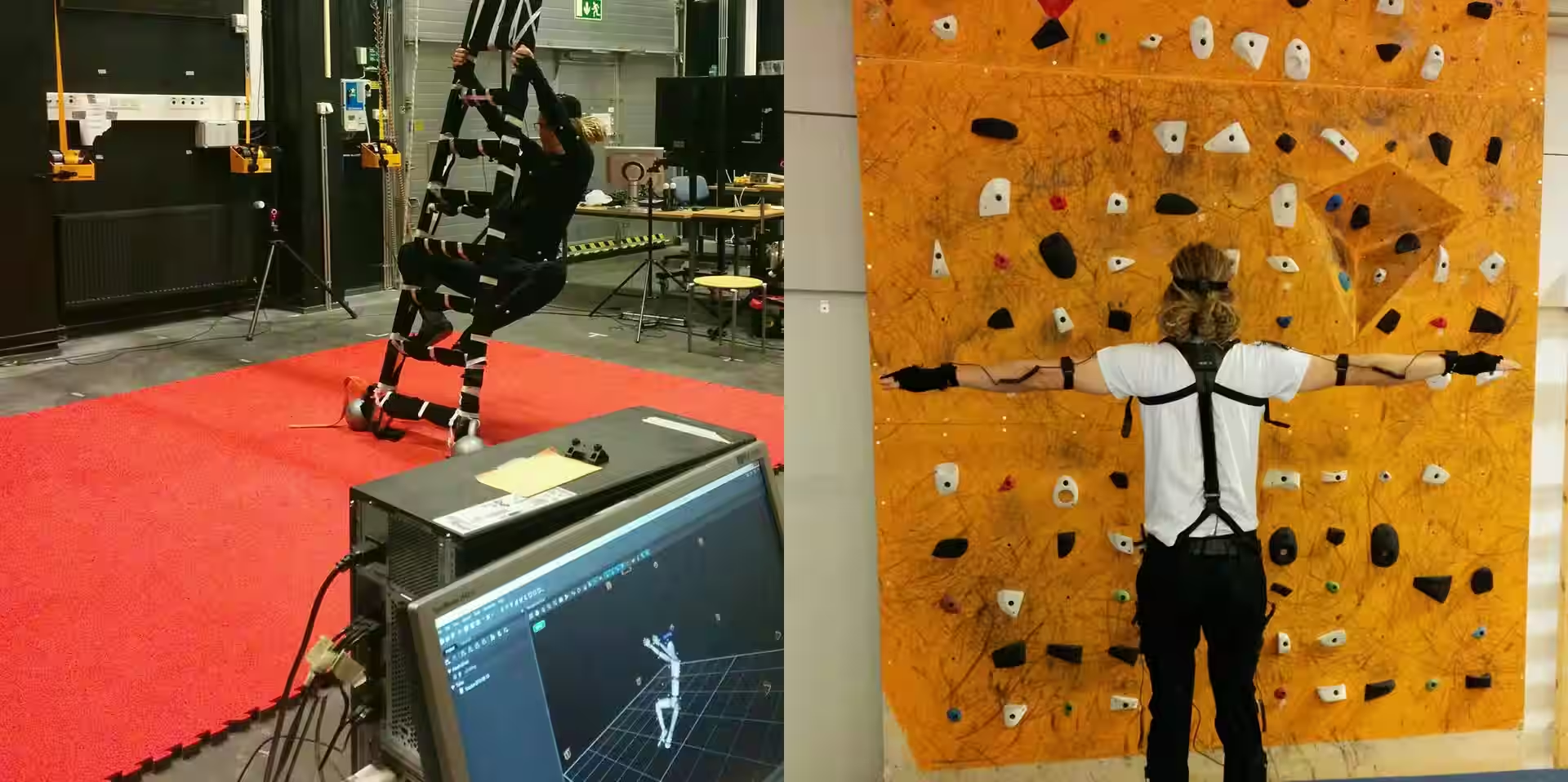
Additional game research confirms that clear goals and visible progress are core to sustained engagement. Players stay motivated when they can see each session moving them forward, through scores, levels, or personal bests. But when a digital experience feels confusing or clunky, guests disengage fast. Poor usability breaks immersion and turns excitement into frustration.
A 2023 study found a direct relationship between player involvement and task difficulty: engagement increases as challenge increases, but only up to the point where the task remains achievable. Cross that threshold, and engagement drops sharply.
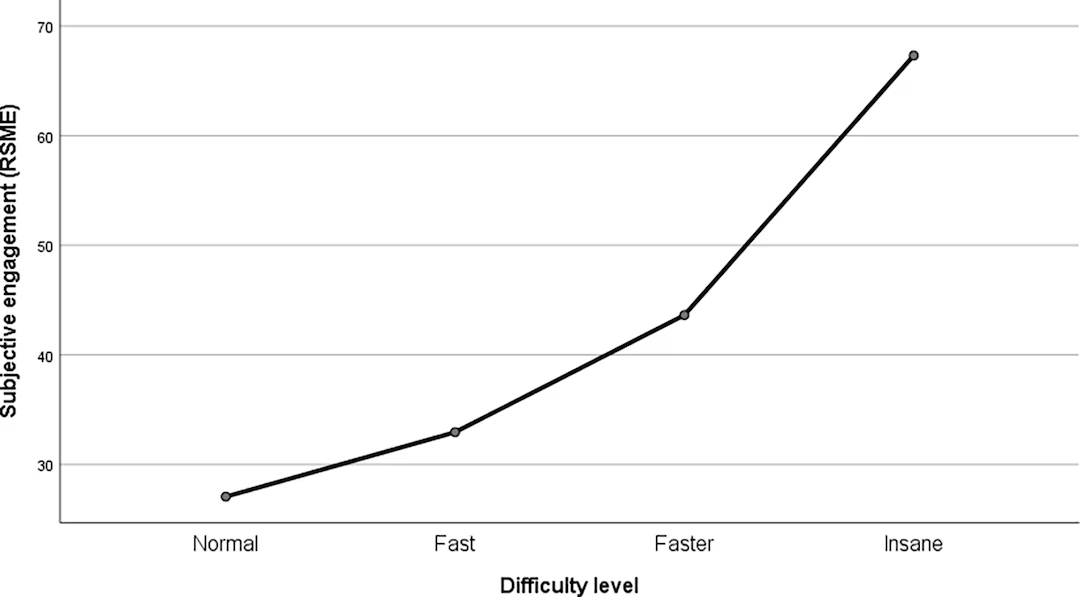
For digital attractions, this translates directly: adjustable difficulty, multiple levels, and varied game modes are not optional extras. They are what sustains replayability across different ages, skill levels, and return visits.
Beyond hardware: Platform vs. machine
One of the biggest risks in digital attractions is obsolescence. What feels cutting-edge today can feel dated in two seasons.
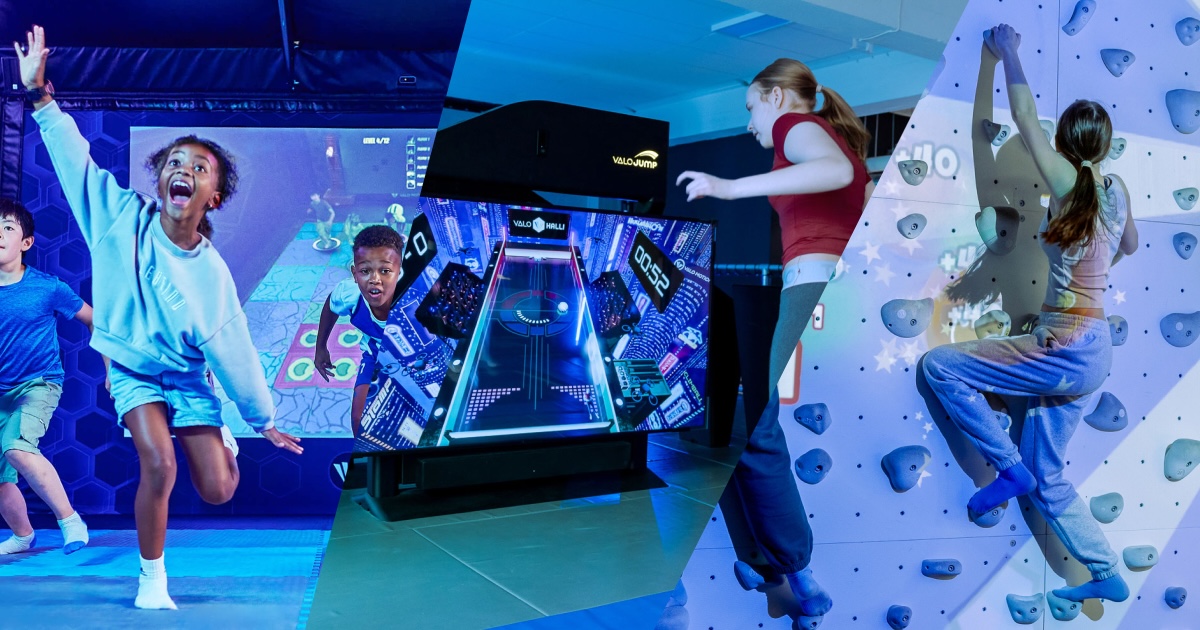
Valo Motion products ValoArena, ValoClimb, and ValoJump are live game platforms. They bring proven digital game design principles into mixed-reality attractions. That distinction has compounding consequences for operator ROI:
- Designed by game creators, not just hardware engineers
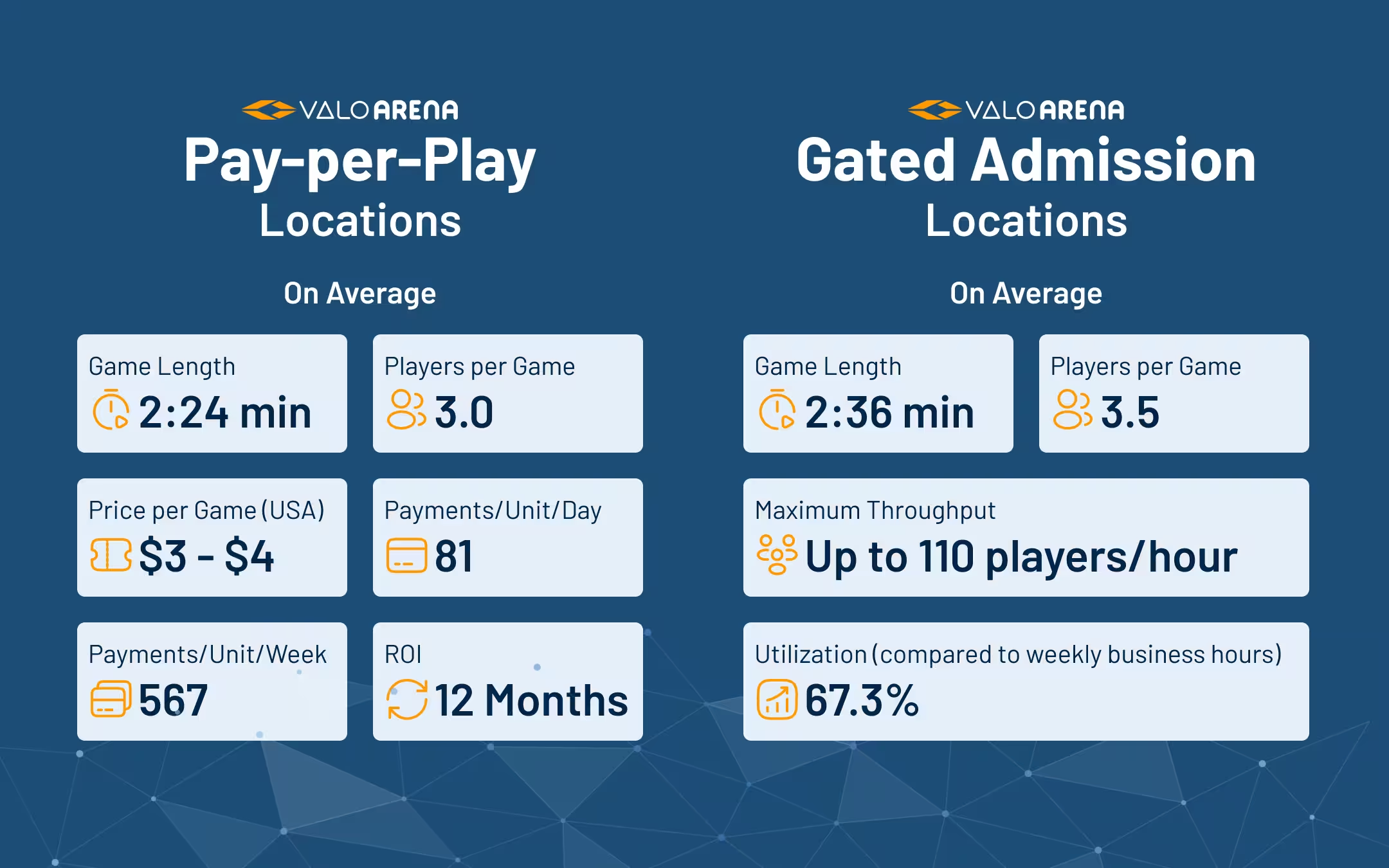
- High throughput and utilisation-% in open access: for instance 110 players/h and 74,3% (ValoArena)
- Average 10-12 months ROI in P2P
- Multiple games, levels, and modes per device
- Group-centric, flexible sessions with deep replayability
- Fully unattended operation, no controllers, easy to play, 24/7 support
- Operations Hub dashboard for gameplay and performance insights
- Regular content updates with new modes, levels, and balancing
- Use case versatility: for FECs, indoor activity parks, climbing gyms, hospitality, and retail.
5 takeaways: choose attractions that drive repeat plays and long-term revenue
Before investing, operators should ask a different set of questions than they did five years ago.
1. Look beyond first-play excitement
An attraction that looks impressive on opening day but lacks depth will struggle to deliver repeat revenue.
Operator lens:
- Does the experience remain engaging after the first few plays, or does interest drop once the visuals are familiar?
- Attractions designed with real game mechanics, progression, challenge, and feedback outperform those built primarily around spectacle in the long run.
2. Prioritise replayability over one-off experiences
High-performing digital attractions behave more like successful video games than static installations.
Operator lens:
- Are there multiple reasons for guests to come back and play again?
- Can players improve, compete, or unlock something over time?
- Replayability is what turns short sessions into repeat plays and casual visitors into regulars.
3. Choose experiences for social play and groups
Social energy drives usage. Attractions that invite spectators, friendly competition, and shared moments naturally create queues, buzz, and word-of-mouth marketing.
Operator lens:
- Does this attraction activate the surrounding space, or isolate the player?
- Group-centric design amplifies both engagement and throughput.
- Does the attraction include built-in video or replay sharing that turns great moments into free, user-generated marketing? For operators, this means: Continuous visibility on social platforms where younger audiences already spend time, increased brand awareness without additional marketing spend, and social proof that attracts first-time visitors who want to try what they’ve seen online.
4. Assess how the attraction ages
Technology ages fast. Gameplay doesn’t, if it’s designed correctly.
Operator lens:
- Will this attraction feel fresh in three years without replacing hardware?
- Does it deliver high uptime without requiring daily maintenance or constant staff intervention?
- An attraction that looks strong on paper but requires frequent recalibration, manual resets, or technician visits quickly eats into operational efficiency and profit.
5. Think in years, not seasons
The most profitable attractions are not the ones that impress once; they’re the ones guests return to again and again.
Operator lens:
- Is this built to deliver value over its full lifespan, or mainly to make a splash at launch?
- When play value is high, revenue follows naturally: more repeat plays, longer dwell time, stronger group bookings, and sustained relevance.
The most profitable digital attractions are not the ones that impress once. They are the ones guests return to again and again, because the play is deep enough to reward repeated engagement, social enough to bring groups back, and well-supported enough to stay relevant over the full life of the attraction.
If you are evaluating your next digital attraction, or wondering why an existing one has lost momentum, we are happy to share what we have learned from over 1,650 installations across 80 countries.