January 5, 2026
6 simple steps to help AI recommend your family entertainment centre
Operation
Mixed reality
Revenue generation
Want to learn more about how to boost FEC marketing with Valo Motion?
Get in touch!

Why AI brand visibility (GEO) matters (even if your park is already busy)
Until recently, most customers found family entertainment centres and indoor activity parks through Google search, maps, or social media. But this is now changing fast. AI chats are growing rapidly, and the digital customer journey is becoming increasingly condensed into a single chat conversation. Being visible in AI answers, not just search results, is called GEO, Generative Engine Optimisation.
Customers ask AI chats like ChatGPT, Perplexity, Gemini and Copilot questions such as:
- “Best indoor activities for kids near me in Sedona, AZ?”
- “What to do with kids on a rainy day in New York?”
- “Is there a good active birthday party venue for 10-year-olds near Mystic, Connecticut?”
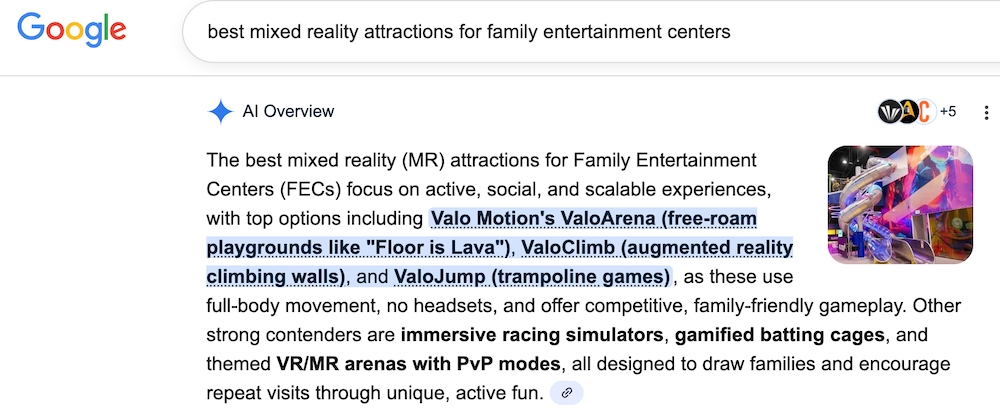
Google also increasingly answers these questions directly on the search results page inside AI Overviews, without sending organic traffic to websites.
- Google AI Overviews are AI-generated summaries that appear at the top or sometimes in the middle of the search results page.
- AI Overviews are not generated for every query or brand term, but typically for more complex queries or open-ended consumer questions.
In both cases, it is important to note that instead of compiling an answer from a single website, AIs read and synthesise information from multiple relevant sources across the web to deliver a fast and comprehensive answer.
If your venue does not show up in AI-generated answers, it becomes invisible in a growing part of the customer journey.
The good news? You do not need a big marketing team or advanced technical skills to improve your AI visibility. You just need to understand how AI finds information and make a few smart, practical changes.
How AI tools find and choose information: So, how does AI “know your venue”?
AI tools don’t “think” like humans. They find information on your venue in two ways:
1. They are pre-trained with existing content across the internet
All AI models are pre-trained on huge amounts of public content and billions of parameters of data: Websites, media articles, social media platforms, etc. This means what already exists about your venue online really matters.
2. They can search the web in real time when answering questions
When someone asks a question in AI chat or AI search, AI tools:
- Turn the question into search queries
- Read content from many different sources across the internet
- Compare the credibility, relevance and freshness of the sources they found
- Create a summarised answer, often citing or mentioning sources, but not always
How can your venue appear in AI answers?
How to make your brand more AI citable? AI prefers content that is:
- Clearly written: well-written, direct explanations over vague or clickbait ones
- Use-case driven, specific and practical: answers the long-form queries and open-ended customer questions
- Evidence-rich: for instance, includes customer testimonials or data to back up your claims
- Frequently mentioned by other trusted 3rd party sources outside your website
- Recently updated
Many operators focus only on their website homepage. AI does not work that way. AI visibility is built from:
- Your website
- Your social media activity
- Third-party mentions (media, partners, articles)
- FAQs (and blog posts) that answer real customer questions
This is great news, because many of these are things you already do; you just need to do them a bit more intentionally.
#1 Social media: your fastest win for AI visibility
Social media is one of the most important information sources for AI tools today.
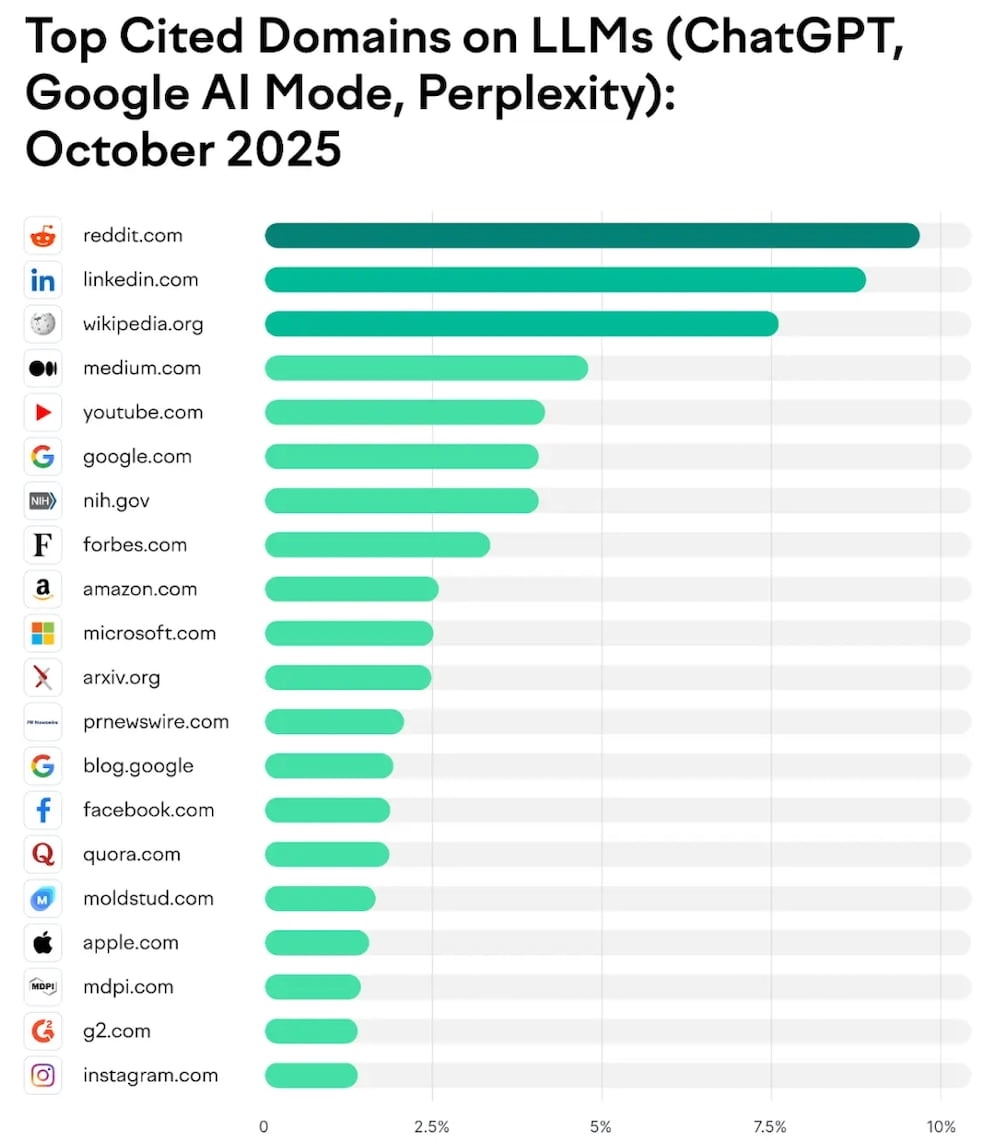
According to the Semrush October 2025 survey (graph below), LinkedIn is the second most cited source for AIs, and YouTube, Facebook and Instagram are all included in the top 10 most cited sources list for AIs.
If you post regularly on these channels, you already have a good head start for AI brand visibility.
What to post (simple rules)
You do not need viral content. AI prefers clear, informative posts.
Good post ideas:
- Explaining what your venue offers (“What is mixed-reality play?”)
- Who your activities are for (age ranges, families, teens, groups)
- Birthday parties, school groups, corporate events
- Safety, supervision, and physical activity benefits
- Short videos showing real gameplay and real guests
How often?
- 1–2 posts per week is enough
- Consistency matters more than volume
Important tip
Use clear language in captions: “Our indoor activity park in Berlin offers active games for kids aged 6–14.” This helps AI understand who you are, where you are, and who you are for.
#2 Create an FAQ page that actually helps customers (and AI)
FAQ pages are extremely valuable for AI visibility. If your website answers the same questions parents ask every day, AI systems are far more likely to recommend you when families search for things to do. With your FAQs, you are training AI to explain your venue the way your best staff member would.
Where to find real customer questions (No marketing skills needed)
1. Ask your own team (Easiest & most accurate)
Your staff already hear these questions every day. Ask:
- Front desk, Party hosts, Call handlers, Booking email inbox managers.
- “What are the top 10 questions parents ask before booking?”
Examples:
- “Do parents have to stay?”
- “Can siblings join?”
- “What ages is this best for?”
- “What happens if it rains?”
- “Can we bring our own cake?”
These questions should always be in your FAQ.
2. Check Google (No tools required)
Google literally shows you what parents are asking in the “People Also Ask” box. Go to Google. Search:
- “Kids birthday party venue near me”
- “Indoor play centre [your town]”
- “Things to do with kids in [city]”
- Look at the “People also ask” questions
- Write down the ones that apply to your venue
These are real questions from real parents.
Google Maps reviews (Gold mine)
- Open your Google Maps listing. Read:
- 3-star and 4-star reviews
- Questions in the Q&A section
Look for phrases like:
- “I wish I’d known…”
- “We weren’t sure if…”
- “Just to clarify…”
Each of these should become an FAQ.
3. Use ChatGPT
Simple prompt operators can copy & paste
“Act like a parent planning a kids’ party or family day out.
What questions would you ask before booking a family entertainment centre?”
Then ask: “Which of these questions should be answered clearly on a website?”
4. Look in your own email inbox
Search your email inbox for:
- “Question”
- “Just checking”
- “Can we”
- “Do you allow…?”
If it’s been emailed more than once, it belongs in the FAQ.
Summary: What makes a good FAQ page?
Answer real questions, such as:
- Is this suitable for a 7-year-old?
- What is the difference between your games and a trampoline park?
- How long does a typical visit last?
- Is this good for birthday parties?
Practical tips
- Write one clear question per section
- Answer in plain language (3–6 sentences)
- Update the FAQ every few months
If your website also has a blog section, you can use it to answer longer questions that don’t fit neatly into an FAQ. Blog posts are ideal for explaining things like party planning tips, age suitability, or what to expect on a first visit, helping both parents and AI systems understand your venue better. Think of FAQs as quick answers, and blog posts as conversations with parents who are still deciding.
#3 Be visible outside your own website (this matters more than you think)
According to academic research from 2025, AI tools trust third-party sources over the brand’s own website’s content. AIs lean on third-party citations, community threads, and trusted publications. They trust what others say about you more than what you say about yourself.
Trusted 3rd party sources for AI include:
- Media articles
- Partner websites
- Paid editorials or native advertising
- Tourism websites
- Shopping centre or mall websites
- Also, your own social media channels as mentioned above
What you can realistically do
You don’t need global media coverage. Start small:
- Partner with your shopping centre or landlord for a joint article
- Collaborate with nearby attractions or family-focused businesses
- Publish a paid editorial in a local or national media outlet
- Get listed on "things to do with kids" blogs or city guides
These mentions help AI see your brand as legitimate and trusted.
#4 Keep your information consistent everywhere
Remember that AIs always compile the answer from multiple websites and sources; they never copy-paste just your own website article. So AI can get confused easily if the information on your venue is not consistent across platforms.
Make sure your venue description is the same on your website, Google Business Profile, Facebook, Instagram, YouTube, and LinkedIn. The same on all the external platforms that cite or mention your brand information.
Clearly state what you offer, who it’s for and where you are located. This consistency increases AI confidence in recommending you.
#5 Fresh content beats perfect content
AI also prefers recently updated information. If your content appears outdated, AI tends to overlook it in favour of newer alternatives.
Simple actions:
- Update 2–3 key pages every 2–3 months
- Add a new FAQ question
- Add a new customer quote or short case example
- Update the “last updated” date when you update information on your pages
You do not need to rewrite everything.
#6 Technical GEO: One important fix to do right now
Make sure your website isn’t blocking AI systems
Many venues accidentally block the very AI tools they want to be recommended by. It’s like putting a “Do Not Enter” sign on your front door, then wondering why families aren’t coming in. Behind the scenes, websites have a simple instruction file called robots.txt. This file tells automated systems (like Google or AI tools) whether they are allowed to look at your website. If this file is set up incorrectly, AI systems may not be able to see your venue at all.
AI systems that look at your website
ChatGPT uses three main automated visitors (called “bots”). If these are blocked, AI systems may skip your venue entirely:
- ChatGPT-User: This is the most important one. It’s used when real people ask questions. This directly affects recommendations and visibility.
- OAI-SearchBot: Used when someone turns on search results inside ChatGPT.
- GPTBot: Collects general information so future AI systems understand businesses like yours.
Other AI bots to allow on your website:
- Claude-Web (Anthropic)
- PerplexityBot
- GoogleOther (Gemini)
What should you do? You don’t need to fix this yourself. Instead, send this message to whoever manages your website (web agency, IT provider, or hosting company):
“Can you please check our robots.txt file and confirm that ChatGPT-User, OAI-SearchBot, GPTBot, Claude-Web, PerplexityBot, and GoogleOther are allowed to access our website?”
#7 How to check if AI can find you?
Once a month, do this simple test:
- Open ChatGPT, Google search, Gemini, or Perplexity
- Ask questions your customers would ask (see Valo Motion's AI visibility test example above = AI Overview image for "Best mixed reality attractions for family entertainment centres").
- See if your venue or brand appears
If competitors appear and you don’t:
- Create content answering that exact question that the competitor was cited
- Post about it on social media
- Add it to your FAQ
This is how you slowly “train” AI to include you.
Final takeaway
AI search and AI chats are not replacing everything overnight, but they are already changing how customers discover venues. According to Semrush, AI traffic to websites is expected to surpass organic traffic by 2028. So it is good to start preparing for this change.
For family entertainment centre and indoor activity park operators, the opportunity is huge: you don’t need massive budgets or complex technology.
You can start improving FEC and active indoor entertainment venue visibility in AI results if you focus on:
- Social media posting and consistency
- Helpful FAQs
- Third-party mentions
- Fresh, practical content