.jpeg)
August 3, 2026
Beyond the screen: How to design mixed-reality games that keep players engaged
Groundfall
Culture
Ready to create games players will never forget?
See open positions

How do you design a digital game that gets players engaged and keeps them coming back for more? While traditional digital gaming relies heavily on screen-based progression, creating long-lasting engagement for mixed-reality games – where players jump, climb, and move freely – is a completely different ballgame.
To understand the secret sauce behind our games, we sat down with Lauri "Maukka" Lehtonen, our Lead Game Developer, who has been steering our game and product design for nearly a decade.
Lauri’s journey into mixed-reality gaming started after studying game design at Aalto University and working at a major traditional digital gaming studio, Rovio. However, he found himself looking for a deeper meaning in his work.
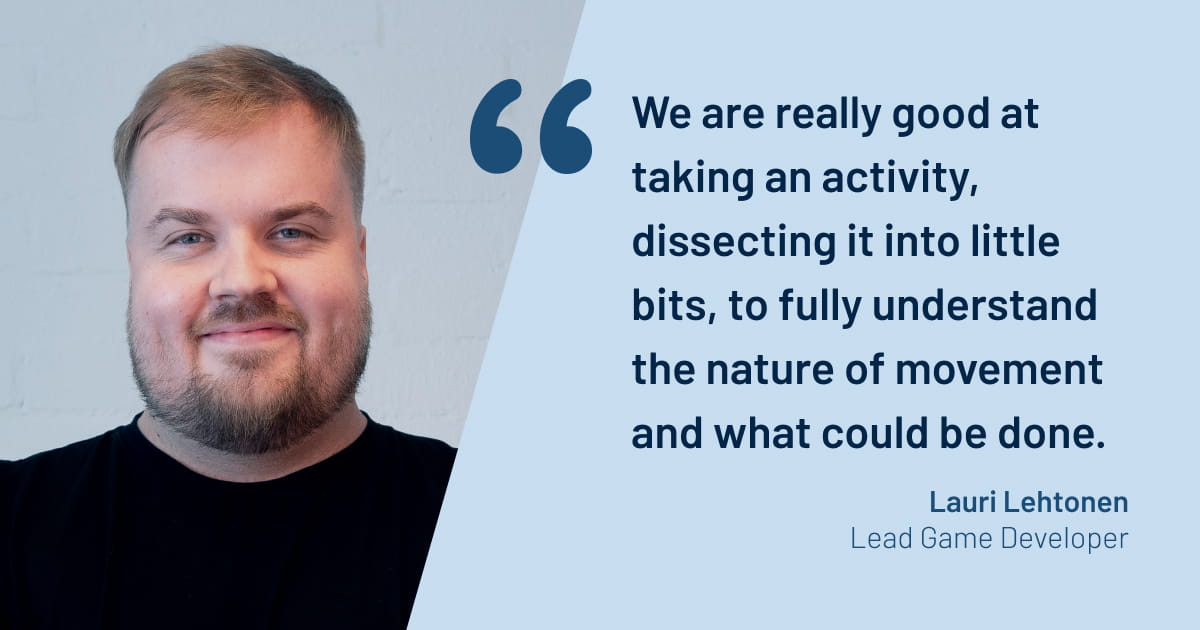
"I was strongly of the opinion that digital games could make physical exercise fun. Games like DDR and StepMania were what really made me feel that way. I wanted to do something more meaningful and go all-in on that idea," Lauri explains his move to Valo Motion.
‘’I was strongly of the opinion that digital games could make physical exercise fun. Games like DDR and StepMania were what really made me feel that way. I wanted to do something more meaningful and go all-in on that idea’’
The 5 pillars of player engagement in active play
According to Lauri, a big part of the game design process is simply getting the player to try the game for the first time. "The game’s appeal has to be high enough. The product must look technically reliable to the player right away, so they don’t think 'this is just a gimmick that won't track my movements.' You have to build that trust immediately," he points out.
Once the player steps in, keeping them engaged relies on five different types of progression: skill learning, in-game progression, self-expression, social bonding, and narrative.
Because our action-packed mixed-reality games usually last around two minutes per round, traditional level-by-level progression can be challenging to implement. Instead, Lauri focuses heavily on skill improvement, social dynamics, and self-expression.
"Once you have mastered a skill, it starts feeling trivial instead of fun," Lauri explains.
"Engagement and fun live in the path to success, not in the success itself. 'Easy to learn but hard to master' is always relevant in game design. A good example of this is Mine Time on our ValoJump. Anyone can immediately progress in the game even by just jumping randomly, but mastering the game and progressing efficiently requires high precision and skill."
Self-expression is another massive factor. “A great example is Astro Blade on our ValoArena. The game allows you to explore and express yourself. Will you stay in place and perhaps defend crouching down, or will you try to circle behind the opponent and attack with rapid pokes or a big spinning swing? When the game allows you to find your own unique way to play, it stays interesting,” Lauri shares
Designing for both competitors and team players
Social dynamics act as a massive multiplier for player engagement. When friends jump into the game, their unpredictable choices create hilarious, constantly changing situations.
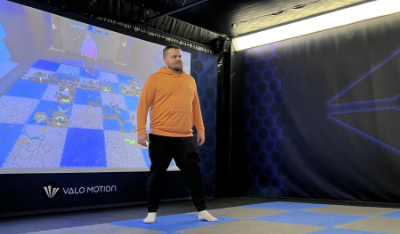
A prime example is the Groundfall game, our highly popular floor is lava survival game for ValoArena.
"If you play alone, you might just run to the nearest safe tile. But when you play with a group, you might realize your friend is closer to that tile, and you have to quickly change your plan or playfully wrestle for the spot. These social dynamics make the game feel fresh every single time," Lauri notes.
To ensure the games hook different types of players, Lauri and the development team design features that reward everyone. For instance, at the end of a round, the game might highlight the individual MVP to satisfy the competitive players, while simultaneously showing the total team score for those who value cooperation.
"We also consider different player types and genres when we curate the game portfolio of our attractions," Lauri adds. "For example, on ValoJump, the younger and more casual players can enjoy Toywatch, while the more serious competitive audience can hone their skills in Jumpball."
A game developer’s ultimate playground
In addition to worrying about frame rates and load times, we worry about whether players will remember to bend their knees on landing. Designing for physical environments is a different beast entirely – and an endlessly fascinating one.
For tech and digital gaming professionals, this offers an inspiring playground. When asked why a game developer should join Valo Motion, Lauri's answer highlights the creative freedom the team enjoys.
‘’Our main goal is always to make the coolest and most fun game possible. We can just focus purely on the gameplay and the player experience.’’
"Plus, you get to explore and solve challenges that haven't existed before in the game industry. You get to do things no one else has done."
Seeing the real-life impact of this work is what makes it all worthwhile. Looking back at his nearly 10-year career, Lauri's favorite memory still brings a smile to his face. It happened at a fitness expo when ValoJump was first introduced.
‘’A bodybuilder at a fitness tradeshow initially dismissed the game, thinking it was just a kids' thing. But when they actually tried it, they were completely hyped! They played multiple rounds and had so much fun. That has really stuck with me,’’ he smiles.
When asked what advice he would give to future game developers who want to create truly engaging experiences, Lauri’s message is clear:
"A game has no meaning unless a player gives it meaning. Think about what novel emotional experiences your game can provide," he advises.
‘’Of course, the technical side matters too. If a game has flaws, players lose trust. But just fixing flaws won’t make a great game: it needs heart. Players can sense the love and effort put into a game. If the development team didn’t care about it, players won’t either. Make games that you want to play. Don't make something you think might be good enough for someone else if it's something you would never play yourself.’’
For Lauri, pouring his heart into game development led him to a workplace where he can focus purely on creating the most fun, meaningful active play experiences possible – and actually see players fall in love with them in the real world.
.png)