.png)
June 1, 2026
From a curious intern to a Senior Game Designer: Why Abhishek Jaiswal swapped screens for trampolines?
Culture
Meet more of the people behind Valo Motion
Read more

Imagine you are a game designer who grew up holding a traditional controller, obsessed with the digital worlds behind a screen. You thought you had seen the full potential of games – until your horizon widened and your curiosity expanded after joining Valo Motion. You are no longer designing just for a monitor, but for mixed-reality games that combine digital gameplay with active movement in gaming arenas, climbing walls, and trampolines. This is the reality Senior Game Designer Abhishek Jaiswal jumped into when he joined our team at Valo Motion.
The journey from a game design student to a Senior Game Designer
Abhishek’s journey into this unique sweet spot of gaming and physical activity started back in June 2020. After working as a game designer in India, he moved to Finland to study game design at Aalto University. When he spotted an open Level Design internship in our team, the unique approach to active gaming immediately caught his attention.
As a designer and developer, you aren't just coding a character to jump; you have to consider the possibilities of human movement and reactions in physical space.
"I thought that something that makes me curious deserves my attention. I wanted to try this out and see if I liked it," Abhishek recalls.
Almost six years later, he is still curious about the possibilities, having evolved from an intern all the way to a Senior Game Designer. But what does his job actually entail in practice, and how does it differ from traditional game development?
Instead of just tweaking pixels for a screen, Abhishek has to constantly consider the possibilities of human movement and reactions in physical space. Over the years, his responsibilities have grown from designing single levels to looking at the bigger picture. Today, he oversees entire products, plans project timelines, and acts as a "glorified communicator" ensuring the developers, artists, and audio designers share the same vision.
“Each product that I work on has its own set of challenges. There's always something new to learn, new things to try, and new ways to design around physical movement.”
"Each product that I work on has its own set of challenges. There's always something new to learn, new things to try, and new ways to design around physical movement. That is what keeps things fresh for me and has made me stay here," he explains.
Ways of working: A culture of rapid testing and low hierarchy
To succeed in building mixed-reality games that have never been built before, you need a very specific kind of culture. Because the games require actual physical movement, the testing process is wildly different from traditional game studios.
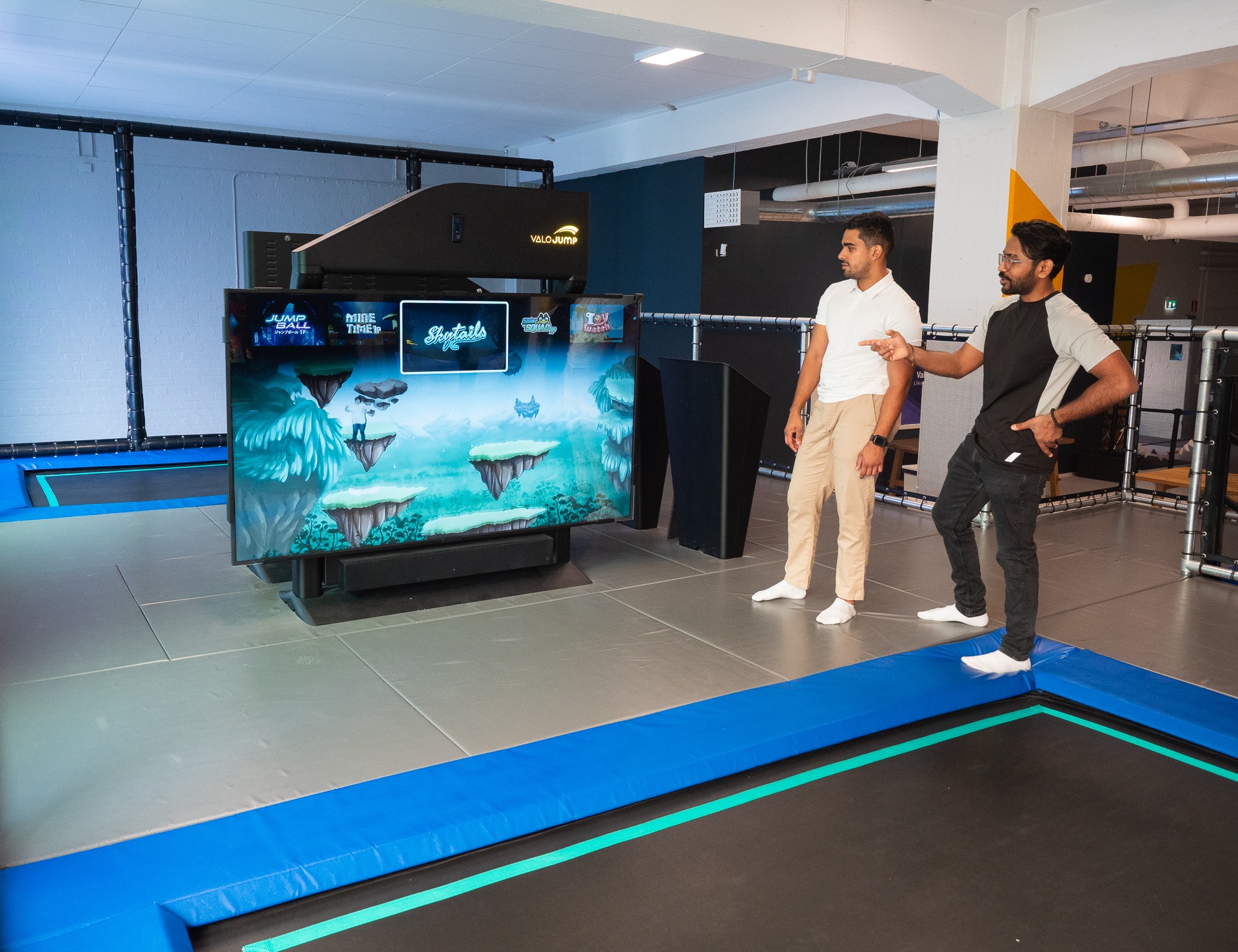
"We base our decisions a lot on how it works with the actual players," Abhishek says. "If we want to experiment with a new interaction, we test that. We keep it only if it feels intuitive and fun. We test the games by physically jumping and climbing in our showroom, ValoHalli. For example, even when I wasn't the main developer for Groundfall: Temple Escape on ValoJump, I was actively jumping on the trampoline to give the team precise, actionable feedback on game speed and visual clarity."
But the culture isn't just about agile testing: it's about the incredibly flat hierarchy and a shared "serious about fun" mindset.
"Even though we've grown as a company, the feeling has remained the same, and we don't have any strict hierarchy. We are all in the same boat. We are at the office in Lauttasaari a lot, and you might even bump into our CEO, Raine, changing a burnt-out lightbulb," Abhishek laughs.
"Everyone shares the same vibe. People are passionate about their ideas but also open to experimenting, because they are open to experimenting and trying out new things."
Small teams and true ownership: The story behind Party Box
In our game development team, game designers work in small, agile core teams. For a game designer who wants to leave a mark, this tight-knit structure offers a massive perk: true ownership of the final product.
"One of the things I like the most is that you get ownership of your game. I can truly call it our game because we work in smaller teams, and we get a lot of freedom in what we want to do and how we want to shape the ultimate goal," Abhishek explains.
One of Abhishek’s favorite projects has been Party Box for ValoArena. As a collection of immersive mini-games, it was an incredibly fun project where he got to see his team's creative vision seamlessly come to life.
"Making games is a team sport. You cannot go there alone, so you have to trust and rely on your team. It is so important to over-communicate rather than under-communicate, so everyone knows what is going on," Abhishek emphasizes.
(Read more about the behind-the-scenes process: How did Abhishek, Ruben & Time create the latest ValoArena game, Party Box?)
The real-world impact of getting people moving
For a mixed-reality game designer, the ultimate payoff isn't just a high score on a leaderboard. It’s seeing the physical impact of your work in the real world.
Abhishek had many opportunities to observe players in action – especially at Valo Motion’s own activity park, ValoHalli – but one moment stood out in particular. During a company visit to a local indoor playground, Superpark Vantaa, where Valo Motion’s products are installed at the customer’s site, he got to witness the actual target audience interacting with his creations in real life. He watched a kid walk up to his game, play it all the way through, and the moment it ended, the kid immediately ran back to the start to play it all over again.
"Seeing children play the mixed-reality games I have helped create, having fun while exercising and moving around, is the most rewarding part of my job," he smiles. "It's fun that we provide a reason to work out, but you don't even realize you're exercising. You just think that you're playing a game and having fun."
"Seeing children play the mixed-reality games I have helped create, having fun while exercising and moving around, is the most rewarding part of my job.”
Final advice: ‘’Be stubborn with your dreams’’
Abhishek’s story is one of curiosity, determination, and making a meaningful impact. In our team, he has found a place where his childhood dream of developing games with an impact perfectly aligns with a mission to get people moving around the world.
When asked what advice he would give to future game designers dreaming of a similar career, his message is clear:
“Be a bit more stubborn with your dreams,” he advises. “Stick to what you want to do and just keep at it till you reach that point.”
For Abhishek, being stubborn about his dreams led him to a workplace where his skills and passions truly shine.
.png)
.png)